
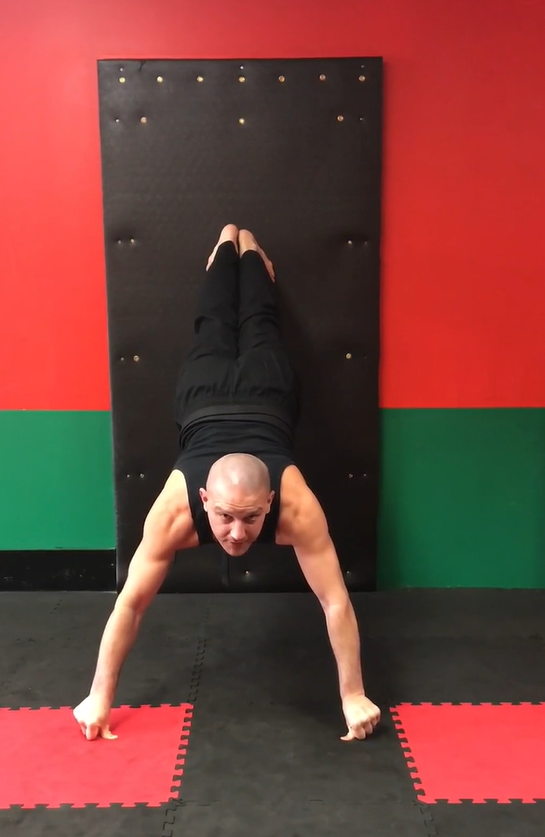
(my thumbs are no different than yours – if I can you can do it better!)
Getting ripped from home is not hard if you have the right schedule, diet, sleep and attitude. The fitness regimen, actually, can range from cardio, high-intensity training with short anaerobic bursts and power lifting or calisthenics movements or balance holds with isometrics. There is more than one way to get great definition and muscle gain.
Martial arts compliments calisthenics and bodyweight training is because it requires large functional movements and adds the “torque” of the body in its coordinated striking drills. Martial arts demands flexibility similarly to some advanced bodyweight static balance holds. Ultimately, martial arts training allows a crossroads of cardio, calisthenics, bodyweight, power lifting and high-intensity interval training.
Here is our basic checklist where everyone wins in getting 80-90% the performance of each “specialist” in peak athletic training in terms of definition, weight loss and dense muscle gain:

- Sleep: If you aren’t sleeping well, or enough, you are losing before beginning. Injuries are notorious in intense programs where people do not get quality sleep. Healing time and deep sleep go hand-in-hand. Aim for 7-8 hours where you awaken feeling well-rested. Avoid napping during the day, avoid darkness during the day so your brain gets the “bright light” exposure for its circadian rhythm, avoid caffeine and sugar products near the end of the day, try to wake up at the same time each day, use melatonin if you have a hard time falling asleep

- Nutrition: Keep it simple and remember some important mantras below:
Do not overeat. Overeating “healthy foods” is still a problem for many people. Healthy foods contain calories and it you are full and trying to finish your plate for the sake of finishing, simply leave it for later.
Do not overdo fruit.
Do not eat junk food, except for an occasional treat.
Do eat more vegetables. Try grilled veggies with olive or avocado oil mixing in some onions with spiced peppers and lemon or lime juice to make it more appetizing.
Do eat more lean protein like white chicken or fish meat, beans and peas (or pea protein powder), nuts or nut flours (try pine nut flour), Greek yogurt, game meats (like bison) and lean beef. For vegetarians/vegans, for sure pea protein and hemp seed protein are two of your best friends.
Do eat more healthy fat. Olive oil, chia seeds, coconut oil, avocados and hemp seeds are your friend.
Eat complex carbs for daily energy, like acorn squash, black beans and oatmeal are great starter foods for the day. Black beans also contain the highest soluble fiber out there which is a plus.
Drink water throughout the day, or water with lemon or lime juice mixed in if water is boring for you.

- Herbs: There are herbs same and simple to boost your metabolism and we will narrow it down to 3 chief herbs that in Indian and Chinese medicine are some of the few herbs used alone without needing to be added to the herb concoctions to have “synergistic effects” as they are powerful enough on their own. These also decrease inflammation and control glucose levels in the body – another plus.
Ceylon Cinnamon – While both forms can affect metabolism mostly through glucose control, for overall health reasons, Ceylon cinnamon (from Sri Lanka and India) would actually be a better choice than the traditional staple cinnamon, cassia, found around much of the world. A ½ teaspoon a day for most adults in the morning is a wise add-on. Cinnamon contains coumarin a substance that can be toxic to the liver and is in much higher quantities in traditional cinnamon cassia form found in most stores.
Turmeric – Technically, this one needs black pepper for the alkaloid “piperine” to better metabolic absorption. Curcumin, the popular substance of turmeric, owns much of turmeric’s medical properties, but not all of them. For speeding the metabolism we recommend taking a supplement of turmeric containing curcumin extract and piperine as well, or simply mixing turmeric and black pepper into lunch or dinner meals if the taste appetizes you. Taking supplements as dosed or adding a few pinches into dinner each day is an excellent choice.
Ginger – For most people 1000mg 3x a day with meals is sufficient – you want the ginger root powder form and if it bothers your stomach you can decrease to 500mg 3x a day. Use caution if you have high blood pressure.

- Avoiding injuries. Many people lose out on peak training because of old injuries or fear of new ones. We have full resources on each of these practices at www.ironmartialartsonline.com, but in short, use isometrics and eccentrics before your bodyweight and weightlifting movements. Lots of muscle, tendon and ligament strengthening through isometric holds, where you stop midway in a movement and contract and “squeeze” the muscles as hard as you can. Aim for 10-30 seconds depending on how hard it is and always breathe (never hold your breath doing this). Then eccentrics are simply the negative motion of a movement (like bicep curls, coming up in flexion to your chest is “concentric”, releasing back down in extension is “eccentric”). The idea with eccentrics, are to focus on the muscle and keep the muscle tension strong while slowly releasing – one of the best ways to prevent injury. Another free tip – get a solid dynamic warmup before training with a nice active isolation stretching cool down after (holding stretch positions for 2-3 seconds only repeating 5x each common stretch).
- Your exercise routine: Enjoy cardio and high-intensity interval (HIIT) circuit training, sometimes on different days, sometimes with HIIT alone as continuous different circuits (which is a form of intense cardio) and other times just strength and powerlifting days followed by simple cardio like running, swimming or bike riding to push your endurance. And every now and then, do a long aerobic workout session (not as intense as cardio but for longer hours to maintain super endurance). Balance and core work, like yoga, is also very important. Quick reminders for each type of fitness to aim each week:
HIIT Circuits: think 30 second bursts by 30 seconds rest of stuff like fast striking combinations, bouncing superman pushups, handstand pushups, L jumps, sprinting, leap frogs, pistol squats, L sits, flying split jumps, donkey kicks, tiger leaps, kettlebells, Indian clubs etc. Always include gymnastics movements too. Aim for 20 minute sessions 3x a week.
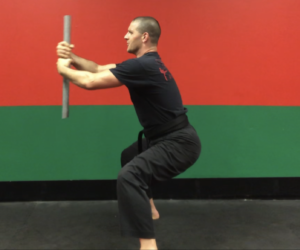
Pro tip: There is another thread of HIIT called torque training we build into our classes using fast circular often whole-body movements using heavy weights (like Indian clubheads, kettlebells or even dumbbells), a hybrid of Olympic weightlifting and calisthenics we sometimes build in, but done carefully to avoid injury.
Cardio: ANY exercise that keeps your pulse roughly above 180-age (this is the estimate calculation that applies to adults without significant health problems), so going at a “good hard pace” for: shadow boxing and jump rope at home, but also can add in biking, running, swimming, or HIIT bodyweight circuits continuously rotating news exercises every 30 seconds, nonstop. Aim for 45-60 minutes 3x a week.
Powerlifting: going 3-8 reps of really heavy lift sets for squats, bench press, overhead press, and deadlifts for example, do 2-3 sets of each, any yes, you can do these lifts a couple times a week, as long as at least 3 days apart for good measure. Good form and technique, not the amount of weight, is your priority. Before each set, with lighter weight, we do our isometrics and eccentrics for injury prevention. Aim for 2 sets of each exercise done 2-3x a week (not on cardio days).
Balance / Core Work: this is the single biggest thing people either focus way too much on, or way not enough of, no one seems to strike a good balance. Yoga and Pilates are also very important. We use “coiling” drills using Tai Chi transitions demanding extreme balance and movements under tension called “compression intent” which challenges the body in a different way. We actually have combined Tai Chi and yoga classes built into daily separate online meditation classes we do. Aim for 30 minutes 3x a week.
Packing / Iron body: This is a unique aspect of our martial arts training not specific to other fitness pieces and really not needed for anyone not doing serious martial arts or tournament training. It’s the idea of tempering the body with striking objects against it, doing reverse breathing for internal training and iron palm (slapping bricks to toughen the palms) and isometric focalized training to fatigue muscles with prolonged contractions to build density and increase pain thresholds. In our online martial arts and fitness classes we build this in each week as an optional section but it is certainly not required for the athletic training mentioned above.
*Generally, do not train to failure for any of these – aim for 80-90% of “everything you got” on a consistent basis. Training to failure and shocking the body should only be a few times a year, but not a weekly thing.
This program will not win you Mr. Olympia for bodybuilding, nor world’s strongman or the winner of an Ironman Triathlon or yogi expert but if you can get 80% the performance of all specialists above, that’s amazing overall fitness very, very few people have.
Using myself and my own students as examples who use this strategy:
*we can easily run a half marathon (13.1 miles) at a moment’s notice
*we can do basic gymnastics like flips, somersaults and handstand walks
*we can easily do intermediate calisthenics with a few advanced moves too
*we have targeted strength development such as one or two finger pushups
*we can hold various static poses, including advanced yoga poses and extreme balance positions
*we can one-rep max squat 2X our own bodyweight, bench 1.5X our own bodyweight and deadlift 2X our own bodyweight which is decent for entry-level powerlifting standards
*we have completed ironman triathlons successfully but not in competitive times
So there you have it. Not too simple but not too hard, perfectly doable for someone who has willpower and makes the time. Here’s a final free tip for anyone who says they’re “too busy” for exercise due to work, children or school:

- Building your training time into paired activities for work, school or taking care of your children. I understand busy. I have a family to take care of and worked my way through 4 Master’s degrees and run our martial arts studio and online program with a separate 501c3 nonprofit. Seriously. And there are people FAR more accomplished than me, it’s not bragging, it’s letting you know, I really am busy too. But for people who refuse to exercise regularly because “life’s too busy”, here are some tips:
I’ve managed the above schedule working as a nurse practitioner working in the emergency department and in the clinic with shifts lasting all day into the evening sometimes. So on those days, when I have only minutes to work with in the morning, I do heavy squats and deadlifts for 5 reps a couple sets. That’s it.
On days I run martial arts classes, we build 20 minute HIIT routines into our online training classes, with a heavier focus on striking combos focusing on form and powerful quick striking techniques, torque training, mixing in calisthenics and bodyweight 30 second circuits. We also include balance work and yoga and Tai Chi forms in our “moving meditation” classes. Yoga, Tai Chi and chi gung, as a side note, can be practiced right in the living room on a mat next to your family during TV in the evening. The idea you need total silence around you is false – what you must learn to cultivate is focus and intent amongst distractions.
On the weekends, I have some time in the morning before the family wakes up and I can sneak a one hour hard run in and will focus on swimming, biking and/or running cardio in these mornings, usually 60-90 minutes, not my complete best endurance but 90% of it to stay sharp. Or maybe you are taking classes or go to the university or have continuing education for your job – I strongly recommend running on the treadmill reading note cards. It makes the time go by faster and used more efficiently.
So yes, you can work two jobs and still have time to train too if you are very careful and clever with your time.